
Welcome to Spreadlandia, where two veteran editors read it ALL to winnow out only the best: juicy yarns, big ideas, deeply personal essays, and hot goss—aka, the full Spread. Plus: original interviews, podcasts, and more. Come hungry!
Serious Spreadvestigators,
Talk about a summer blockbuster. The Amy Griffin Detective Agency (that’s us) is happy to share its latest briefing. Kick off your fisherman sandals and crack a fridge ciggie: this one’s a doozy. The Spread’s favorite billionaire, MDMA expeditioner, pal-of-Oprah, and seemingly disgraced—wait, maybe not!—memoirist has re-entered the chat with the full force of her power as the venture capitalist wife of maybe the richest man in New York.
When we last left this saga, a woman filing as Jane Doe had sued Amy Griffin, claiming that the recovered memories of sexual abuse Griffin described in The Tell were actually her own experiences, and that Griffin had obtained them through an elaborate ruse: a man named Dominique Price—who, oh so randomly, turns out to be a guy best known for extensively smooching a fellow contestant on Season 2 of Temptation Island—allegedly posed as a talent agent/producer to extract her story under false pretenses. The suit also named Griffin’s ghostwriter Sam Lansky and publisher Penguin Random House.
Jane Doe filed her suit in March, while Amy was sitting front row at Schiaparelli at Paris Fashion Week (she and designer Daniel Roseberry are tight). For three months, things on this front have been suspiciously quiet, with nary a blip from our “Amy Griffin” Google notifications. But you had to know the crisis PR and law firms were whirring hard behind the scenes. On Monday, Willkie Farr & Gallagher—which legal eagles out there will recall as the white-shoe law firm that just represented Blake Lively in her deathmatch with Justin Baldoni—retaliated, unmasking Jane Doe’s identity and filing both an “anti-SLAPP” motion (to ask the judge to throw out the Doe suit) and a defamation lawsuit accusing Jane Doe of painting her as a liar and a trauma-thief.
We spent the last two days slow-reading both filings and texting each other every three minutes to bring you, in no particular order, the six biggest surprises revealed in Case 2:26-cv-01811: Griffin v. Altum, filed in the U.S. District Court for the District of Nevada on June 15, in the year of our lord 2026. We would like to acknowledge that this very fine read is for people who have been following this case closely—because we know we’re not alone out there!
First, a little context: The Tell makes an inordinately big deal about a dress that Amy loaned to a girl in middle school named “Claudia”—we later learn this is because Amy suspects Claudia was also abused by “Mr. Mason,” the teacher who allegedly raped Amy. In the book, Amy writes that she tried to corroborate her recovered memories by reconnecting with Claudia, but that ultimately, Claudia denied being abused. Jane Doe says she is the real “Claudia,” and that Amy stole her story.
Griffin’s filing says that’s bunk: That Jane Doe is not the character she calls Claudia in the book, and that while she and Jane Doe did go to school together, they have never met as adults.
Griffin denies Jane Doe’s allegation that they met in a coffee shop in Palm Springs in late 2019—a meeting that Jane Doe contends is portrayed in the book as the meeting with Claudia. According to Griffin’s filing, she met the real “Claudia” in April 2023, in a coffee shop thousands of miles from Palm Springs, along with ghostwriter Sam Lansky (his presence will come as a surprise to readers of The Tell, which positions this encounter as a somewhat delicate discussion: one woman telling another—who she hasn’t seen in thirty years and never knew well—that she believed she had been raped.)
And then there’s that fateful borrowed dress… a crucial detail of which, according to the new filing, Jane Doe has got wrong: “[Jane Doe’s] reliance on the story of Claudia borrowing Griffin’s floral dress to plead her case only shows her hand.” In the book, and in Jane Doe’s later filing, the dress is described as “floral.” Now Griffin says that, in reality, it was pink, a detail that was deliberately changed in the text to protect Claudia’s identity. They say that if Jane Doe was really Claudia, she should know that.
Griffin alleges that she had finished a draft of her story before Jane Doe alleges she was even contacted to share her story. The filing says: “Simply put, Mrs. Griffin could not have stolen in April a story she finished writing in March.”
Griffin has real beef with the New York Times, for the September 2025 story that started The Tell’s unraveling, “The Billionaire, the Psychedelics and the Best-Selling Memoir”—which the filing calls an “investigative hit piece.” (We had plenty to say about it here.) Griffin blames reporters Katie Rosman and Elisabeth Egan for introducing Jane Doe to The Tell in the first place; text messages show Jane Doe had never read it until the reporters Amazon’d her a copy on June 28 of last year. Griffin’s lawyers accuse the reporters of going into the story determined to discredit The Tell, claiming they “methodically and deliberately elicited information” to bolster a “sensationalized theory…fueled by suggestive journalism and seized upon by an avaricious plaintiff to shake down a wealthy defendant.”
Rosman and Egan allegedly knew that at least one part of Jane Doe’s story did not hold up. In his affadavit, Price maintains that before last September’s bombshell story was published, Rosman reached out to him to verify the phone call between himself and Jane Doe—the call in which she says they brokered a deal to tell her story. Price says he told Rosman that he’d never heard of any of this—not Amy Griffin, not The Tell, nada. (Curiously, it does not say that he’d never heard of Jane Doe herself…) If Price did speak to Rosman and said what he said he said—we know: it’s a lot—it’s not clear why the Times reporters didn’t mention that he failed to corroborate Jane Doe’s story.
This one blew our minds, so to speak. After describing Amy’s process of recovering her memories via MDMA, the filing drops in a brief but curious detail: “An expert in MDMA therapy has since reviewed Mrs. Griffin’s memories and concluded that they were recovered before the drug took effect.” (Italics ours) Hang on, isn’t the whole premise of The Tell that she unlocked buried memories by taking these drugs? We can’t help but wonder if this clause is intended to boost the legitimacy of her traumatic memories, just in case she ever does have to go to court to defend them. Because, as your own Spreaditor Maggie reported here, MDMA experts are happy to tell you that the drug doesn’t work the way she says it does in The Tell.
The filings reveal that, to date, Jane Doe has shared no proof that she ever met with Amy or with the guy from Temptation Island. No phone logs, no text messages, no emails, no travel records indicating she traveled to Palm Springs.
And while the Price affidavit looks good for Griffin, what would have really helped her case was if the real Claudia—even anonymously—had gone on the record. If she’s out there, will the real Claudia please stand up?
Also up for grabs: So far the response online has been anti-Amy—will that tide turn yet again? Will Griffin sue the Times? Will Jane Doe produce evidence and fight back? Will this mess slip away from the discourse entirely? And in that case, what are we doing with all this free time?
Love ya more,
Rachel & Maggie
P.S. We would like to apologize for the preponderance of heteronormative female hotness in this issue. It just shook out this way, we promise!!
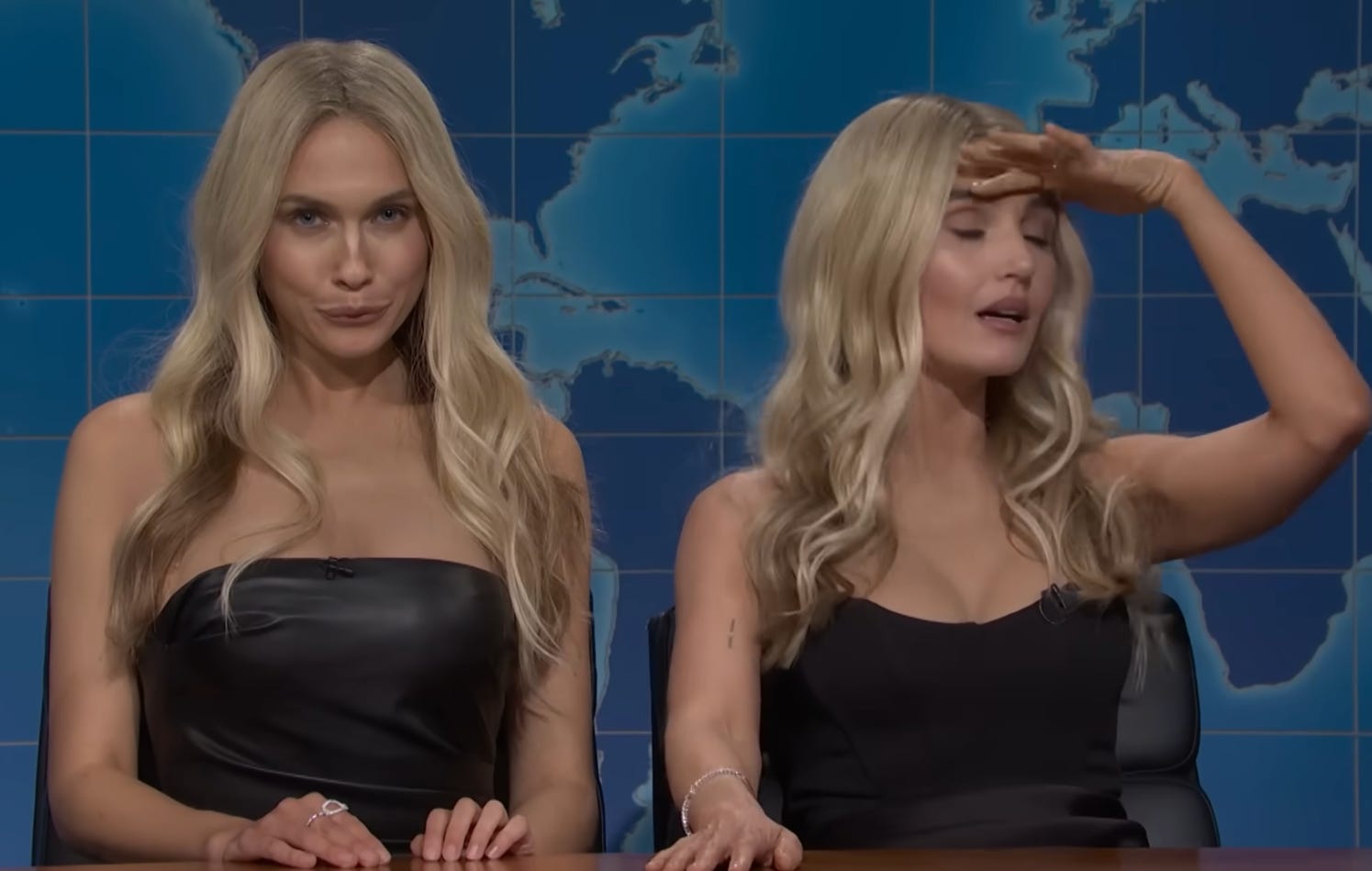
Beef, Season 3
We all saw the smoke wafting from Call Her Daddy host Alex Cooper’s Unwell empire, but Vanity Fair writer Clara Molot motored right on up to the barbecue. The surprise was that the girlboss-centric outfit turns out to be a sausage fest thanks to Cooper’s husband and business partner, Matt Kaplan, who, in cahoots with chief brand officer T.J. Marchetti, runs her company day to day. The story paints the workplace as a first job for many of its employees—most of them young women—as a couple of hot-headed men run amok, dropping f-bombs, evaluating female bodies, inquiring about staffers’ sex lives, and causing panic attacks. According to the piece, Cooper at times just stands there watching the action. Because we’re feeling extra, uh, legally minded these days, we’d like to quote from a letter that Kaplan’s—and Justin Baldoni’s!—attorney, Bryan Freedman, addressed to VF publisher Conde Nast: “If the Story so much as suggests any sexual impropriety on Mr. Kaplan’s part, I will make it my life’s mission to ensure Vanity Fair’s days are numbered.” Did someone say smoke? Also, speaking of Unwell, last week the brand joined Substack with a “magazine”—hey, why not—called Unsaid, which we guess makes us…sisters?
Read the story here.


Tonight We’re Gonna Party Like It’s 1855
Yesteryear fever is burning up our feeds like a raging case of cholera with a typhoid chaser, and gosh do we relishhhhhh a monocultural moment like this. (Our hot take: Yesteryear is the new Gone Girl, Natalie Heller Mills is the new Amazing Amy, the Angry Woman is the new Cool Girl. Also: We did like the book, including its controversial ending—not, it would seem, a very popular POV—and we would love to get into it with you on a slower newsweek. Amy Griffin does not sleep!) Publications desperate to get in on the craze are going to great lengths: Take the usually discerning Vulture, which ran an extremely long, absolute nothingburger of an interview with Ballerina Farm, aka Hannah Neeleman, who supposedly inspired Caro Claire Burke’s novel. British GQ shot Amanda Seyfried—Mother Ann to us, always—in Neeleman drag for its summer issue. Which led us to think about how Seyfried, not ole Annie Hathaway, would be the Natalie of our dream casting. But then we began to wonder whether even with access to Hollywood’s best beauty “tricks,” both of these millennial lionesses might be a liiiiittle too, uh, seasoned—at 40 and 43, respectively—to embody Natalie, who we meet at college? Perhaps Anya Taylor Joy (30) or, playing against type, Saoirse Ronan (32), who’s done the straight woman thing for decades but who we know can flash a sinister streak (see Atonement!). Not that we’ve spent a lot brainpower on this or anything!
Generational Energy
In a Paris Review essay about love, loss, family, and Florida, Greta Rainbow—a friend of the Spread who it must be said is significantly cooler than we are—writes about a jaunt to a séance in the self-appointed Psychic Capital of the World, a village in Florida called Cassadaga with her mother and her Mimi. It’s an ideal bedtime read if you ask us, ultimately more about the power of observation (Greta’s) than the power of psychics.
Read “A Diary from the Psychic Capital of the World” here.
Hassle and Flow
Olga Khazan really seems to relish being the Atlantic’s resident grump on the social science beat. (Remember when she tried to change her personality? We never bought that her heart was in it. ) This week she tackles friendship in the Atlantic: she’s long questioned the axiom that relationships are the best thing for our well-being; now, to her delight, research has caught up. Recent studies have proven that difficult relationships—often with members of one’s own family—can wear a person down beyond irritation and into depression, anxiety, and worse health overall. The scientific name for these people? Hasslers. What’s more, one researcher asserted that women are more likely to be hassled (sure) but we’re also more likely to do the hassling (also, honestly, sure). The upshot, though? Unless the hassling reaches Baby Reindeer levels, most people are healthier being hassled than being lonely. And there you have it—another point for the optimists among us!
Read “There’s a Name for People Who Drain You” here.
Single and Fabulous
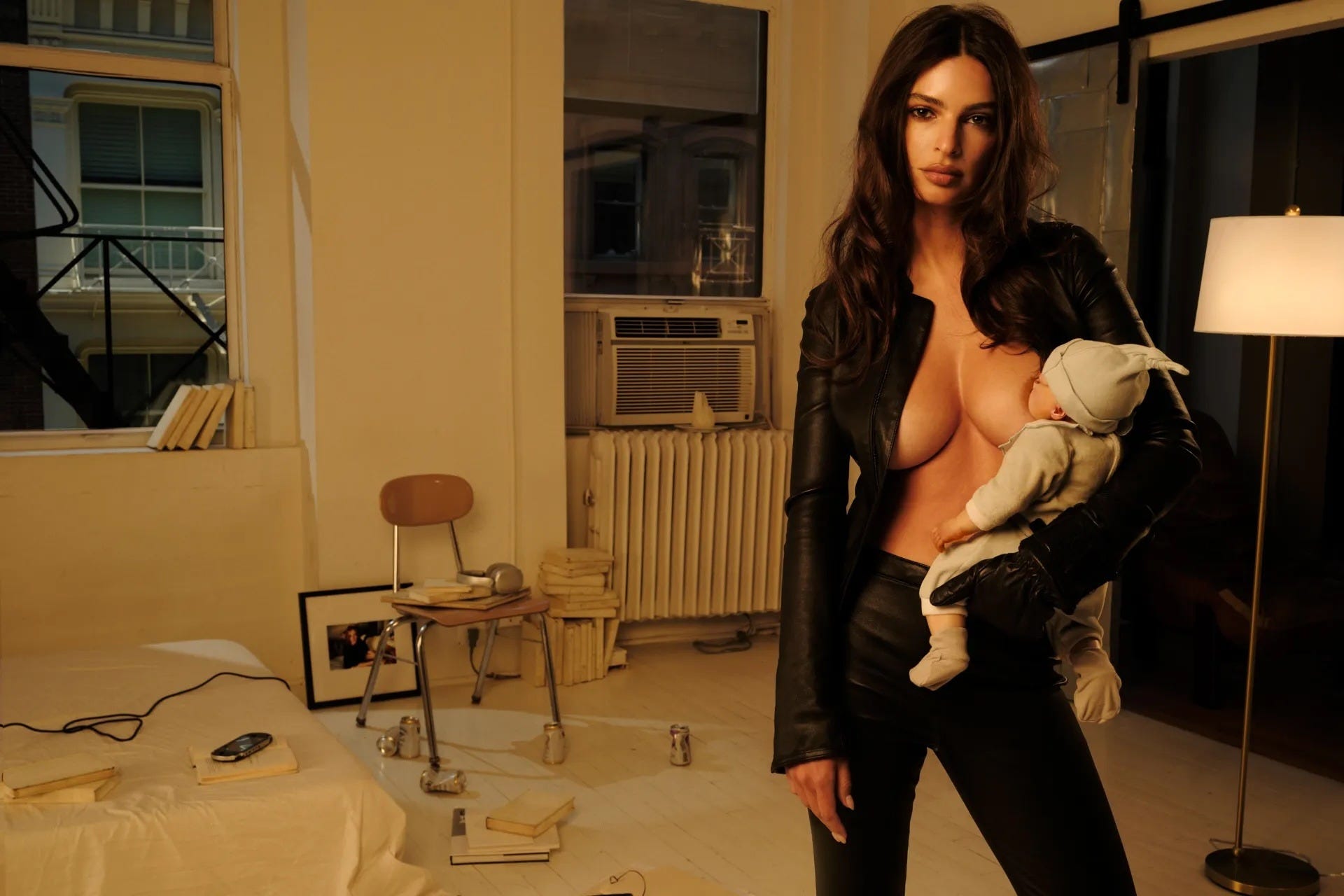
Speaking of Gone Girl! In this week’s New York, Emily Ratajkowski is doing a different kind of boob trick than that time she was “handpicked” by Ben Affleck for a David Fincher film back in 2013: This time she’s “breastfeeding” what has to be a babydoll while wearing a leather Gucci jacket and pants. (Her real-life son is 5. It’s called acting, people.) The photo is the opposite of Carrie Bradshaw’s experience with the mag. It accompanies an essay headlined “Mother F*cker”—pretty good—about coming back into one’s own sexually after having a kid and also a divorce. Emrata, as we’ve learned, can write, and in this essay there’s clever excavation of the trope of the single mom and some delightful turns (at the start of her journey, she envisions herself as “Erin Brockovich of Canal Street”). A relatable tale this is not. See photo above.
Read it here.
No Other Choice
Another abortion story that anyone who doesn’t think abortion is healthcare should read: Jayme Serbell writes in Vogue about the non-choice choice she faced during her pregnancy with twins—abort one fetus or both would likely die. After the birth of the healthy twin, she continues to grapple with the duality of life and loss. But, she writes, “I’m not afraid to say the word abortion out loud, because to me it’s not some scary, terrible thing. An abortion saved my son’s life.”
Read “The Abortion That Made Me a Parent” here.
Did someone forward you this email? To get the full Spread with all the fixins every week…
Gurls, looking at that photo of slender, bosomy Emily and the "baby," there were so many questions! Among them, What is real? x
I waited until today to read the Griffin piece. A wait well worth it!