
Welcome to Spreadlandia, where two veteran editors read it ALL to winnow out only the best: juicy yarns, big ideas, deeply personal essays, and hot goss—aka, the full Spread. Plus: original interviews, podcasts, and more. Come hungry!
Spreadestials,
Back-to-school season has always been sick season. In 2026, as a review of this week’s best journalism shows without question, it’s also measles season. And therefore also the season of spending hours upon hours reading about people in the thick of it. Last week, Pennsylvania governor Josh Shapiro announced two “measels-associated” deaths, as the viral disease rips through Lancaster County. While there have been at least 2,777 confirmed measles cases in the US this year, New York Times Opinion contributor and M.D. Rachael Bedard has deemed Shapiro’s declaration hasty and ultimately unhelpful in the larger war against MAHA’s anti-vax effort, since the cause of both deaths—including a newborn baby whose mother had measles while pregnant—is being contested. Bedard’s op-ed is a wise critique of the political theater on both sides of the vaccine misinformation rats’ nest, one that we—as people who tend to come out swinging in our self-righteousness—took to heart: Sometimes the more strategic move in such heated situations would be to slow our roll. “In a polarized environment where vaccine-hesitant Americans lean Republican, [Shapiro’s] approach was geared toward the wrong public: affirming to liberals and alienating to the very people he needs to reach.” (Speaking of Shapiro, we’ve been looking for an opportunity to start lobbying SNL to cast Nick Kroll to play him during his inevitable presidential run. What do ya say, Lorne? And while we have you: Thanks for being a paid subscriber, Lorne! All the rest of you: Be like Lorne, if you’re not already!)
The Atlantic dispatched staff writer Tom Bartlett to Pennsylvania to track down the Amish parents of the baby who died, revealing the very human grief—and total absence of political ideology—hiding beyond the politics. And the New Yorker jumped into the conversation with a careful, expertly calibrated feature on “The MAHA Custody Battle”: a harrowing and empathetic account of a family that is quite literally ripped apart when the mother—herself a MAHA “micro-influencer”—refuses not just vaccinations but necessary medical treatment for her three children, one of whom has a genetic spinal disease. Scared shitless, the father, who has an online following of his own, eventually fights back. When author Ruby Cramer says that she believes the mother was trying to do right by her children, it lands.
If that’s not enough grab-you-by-the-throat MAHA parenting content for you, you’re in luck—and you also should probably go talk to someone: Yesterday, the New York Times Magazine hit publish on Elizabeth Barber’s “Why MAHA Rallied for a Mother Seeking Alternative Treatments for Her Son’s Cancer,” which touches on all the politics and the heartbreak, but also one villain after another in Oklahoma politics—from gubernatorial candidate Mike Mazzei to a state senator to a Moms of Liberty leader—that enabled a mother to keep her son from standard leukemia treatment. The story is fiercely reported, expertly told, and very much worth sticking with until the end.
Whew. If you’re looking to read just one, well, pick your poison,
Rachel & Maggie
P.S. We just heard the jury for the Lindsay Clancy trial is deadlocked again. Bless these people. All of them. Clancy, of course, but also these jurors, lawyers, admins—all of the people who’ve had to live and relive this hell on earth around the clock for what must feel like an eternity.
The solution is coming from inside the building.
Anna Wintour has certainly courted controversy before—who can forget the “Desert Rose” of 2012 or, for that matter, last year’s Sánchez-Bezos-pocalypse? But we can’t remember her ever being caught in a shitstorm quite like this one, with John Galliano announcing this week that, despite Wintour’s best efforts to rehabilitate his legacy, he will not be the subject of this year’s Met Gala show. Hoo boy, the talkers be talkin’. Amy Odell is one of many to declare this “the end of Anna Wintour’s reign as the most powerful woman in fashion,” pointing out something we’d missed earlier: rumors that Galliano has also made other public anti-Semitic and anti-Asian remarks, even after he’d dried out and mea culpa’d. Lauren “a voice of a generation” Sherman ponders (in a notably well-wordsmithed post: turns out Puck does have editors when they need them!): “You could argue that Galliano’s transgression should preclude him from this sort of iconic exhibition treatment, or you could suggest that atonement is a principle of civility. You could even assert that museums and artistic institutions exist to platform this sort of emotional and intellectual complexity… I have said that I’d suspected that [Anna] believed it was the right thing for her to do.” And Robin Givhan argues that, done right, a show could have successfully examined “Mr. Galliano’s profound failings closely and without hesitation — not as unfortunate asides to his career but as something central to it.” It could even have helped “people understand how antisemitism takes root and grows in the mind of someone like Mr. Galliano.” But it can’t do that if it’s attached to the most outrageous pay-for-play fashion party of the year. Put the Met Gala out of its misery, says Givhan, which is pretty close to shouting, Off with her head!
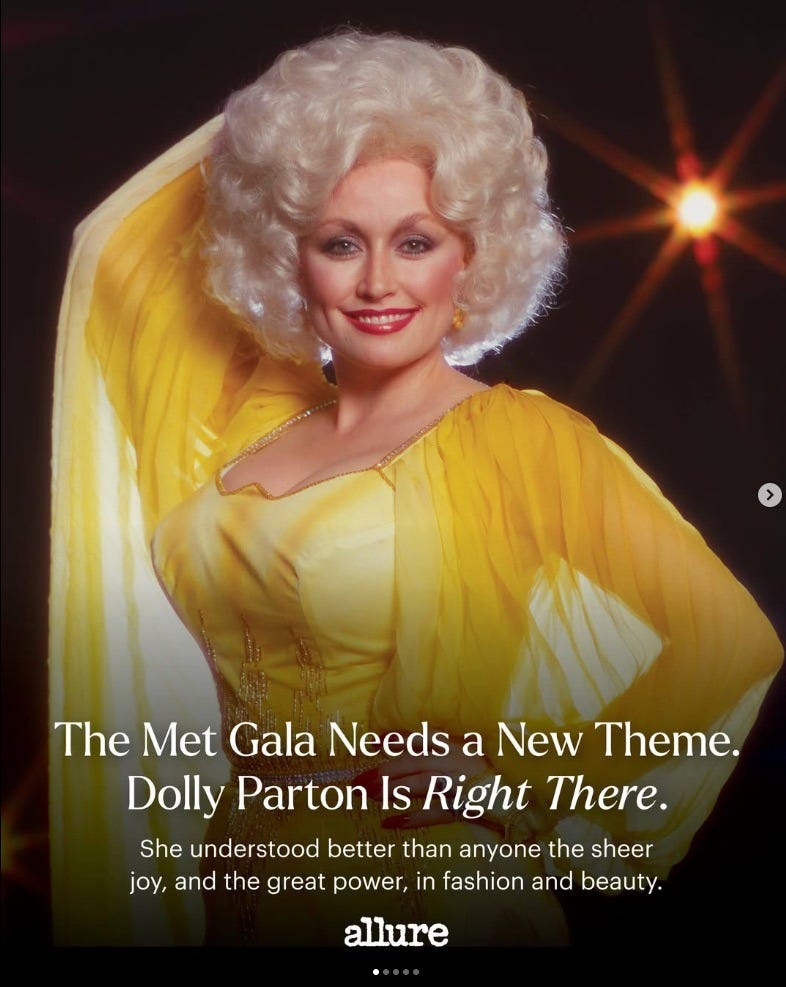
Our favorite solution came from the plucky IG account of Condé’s own less-shiny star, Allure. Yes, yes, yesssss, let’s do a Met Gala about Dolly Parton! Think of all the sub-themes to explore: Americana, Nashville, country music, WIGS, Southern conservatism, religion, drag queens… rhinestones! Imagine what Rihanna, Beyoncé, Sabrina Carpenter, Ru Paul would wear! We cannot think of a better antidote to the hatred with which the name John Galliano, like it or not, will be forever tainted.
May we also humbly suggest that Miss Piggy be the night’s celebrity “host”? Angelica Jade Bastién just did the legwork for this idea, proclaiming the porcine dream “our last female movie star”1 in the mold of Mae West, Elizabeth Taylor, Joan Crawford, and Bette Davis, women whose “lives and cinematic work played out ideals about femininity and its expectations in American culture writ large.”
