
Attention, please: It’s a big day in Spreadlandia! This afternoon we learned that the Spread—yes, this Spread—has been named a finalist for the Oscars of our industry: the National Magazine Awards, aka ASMEs. (Are we being grandiose? Yes, and we’re not sorry!) Cross your fingers, and mark your calendars; winners will be announced in NYC on May 19. Thank you gorgeous readers for keeping us afloat, and giving us a reason to spread the word on juicy yarns, big ideas, deeply personal essays, and hot goss every week. And for just generally being the wind beneath our wings. To celebrate: No paywall this week! Also: If you spot a typo in this issue, chalk it up to us being too excited to see straight. (What? We’ve never claimed to be chill!)
Now back to our regularly scheduled programming…hope you’re hungry!
Spreaders,
A scene from the before times: In 2013, a couple retired to the South of France. They rented a yellow house with blue shutters. There was sun, cicadas, olive trees, a swimming pool. As soon as the grandchildren arrived, they would throw down their things and jump in. The husband cooked, he did DIY projects, he was athletic, he was tidy. Sometimes, friends would ask the wife, “Doesn’t he have a brother?”
Since we last met in Spreadlandia, 73-year-old Gisèle Pelicot—the real woman, not the media cut-out—has emerged via an “astonishing” and “extraordinary” memoir, A Hymn to Life: Shame Has to Change Sides. We knew the facts: She thought she had a happy marriage, only to learn, 50 years into it, that her husband regularly drugged her to unconsciousness and invited dozens of men (found in a chat room called “Without Her Knowledge”) to come into that yellow house and rape her while she lay slack-jawed and motionless, snoring through it all on video. We knew that in 2024 she took the stunning step of waiving anonymity and demanded a public trial, which made her a feminist icon in France. What we didn’t know was her.
Now, stories about the book are coming out daily, with good reason. In a rich profile in British Vogue (pour one out for women’s magazines, which really can do this best—if somebody would just buy some goddamn advertising!), veteran Gaby Wood explores the story through the lens of the specific sexual mores of France—where swinging and BDSM are considered libertinisme, and until 2021 there was no legal age of consent—and where the beloved icon “Gisèle” has become a legal and cultural change agent.
Sophie Gilbert widens the aperture in the Atlantic, asking not just, “What kind of man does this?” but, what happens when men refuse to take on the shame, as Pelicot’s book title demands? Gilbert brings other stats to bear: In 2024, some 83,000 women and girls were killed intentionally, 60 percent of them by their intimate partner or a family member—that’s 137 a day. (vs. the 11 percent of male victims killed by an intimate partner or family member.) And this, from a sexual abuse expert: “A relationship is the best avenue to sexual offending. It is the path to love, trust, hope, and denial.”
How many rapists can there be in one tiny town, asks Lulu Garcia-Navarro, in the New York Times’ The Interview? Wood points out that many of the 51 defendants at Pelicot’s trial, ages 22 to 70—“Parrots, deplorable mouthpieces, violent, cowardly little people,” Pelicot calls them in her book—were “professional guardians of public life: nurses, firefighters, a prison warden, a journalist, a soldier.” Two thirds were fathers; most lived within 50 kilometers of her home. “They claimed to have neither the intention nor the awareness of committing rape.” Some said they were just being polite—doing what their host told them to do.
Unsurprisingly, Rachel Aviv goes the deepest, constructing a full psychological portrait in the New Yorker that pulls harder on threads that other stories mostly hint at: the devastating way this story has splintered Gisèle’s own family, estranging her from her daughter Caroline, who believes she too was drugged and raped by her father, and whose anguish Gisèle could not—or would not—publicly affirm in court. (Readers: he stored photos of Caroline asleep in underwear that she doesn’t recognize in a file labeled “my daughter naked.”) Aviv also explores the possibility of haunting generational incest, Gisèle’s son’s questionable paternity, and the tenuous, day-by-day reconciliation that may or may not hold.
Some of you told us that reading any one of these stories felt like too much to handle. Reading all of them, all together? Intense. We can’t un-learn that in the weeks after Dominique Pelicot knew police were onto him, he doubled down, raping Gisèle three times in less than one month. Or that one of the attackers’ female defense lawyers was suspended after posting a video on social media miming to “Wake Me Up Before You Go-Go” in reference to Gisèle.
You might start to wonder, in a world that seems to be crawling with Diddys, Epsteins, Weinsteins—and the powerful people who knew what they were up to and looked the other way—not just what is wrong with men, but what is wrong with humanity?
But here is what comes through in every story: Gisèle does not. She has a new boyfriend, a new life, and while she has no desire to forgive the man she refers to as Monsieur Pelicot, she has not emerged from her ordeal hating men. Wood observes in her “a palpable sense of freedom, and an almost unearthly transfer of optimism to those in her midst.”
Vive Gisèle!
Rachel & Maggie
Gay Issue(s)
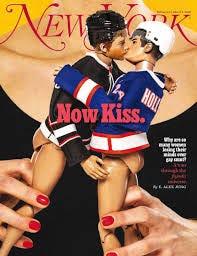
On Tuesday night, when the gold medal-winning U.S. men’s hockey team trooped into the U.S. Capital to bend the knee for Trump’s State of the Union, we were sure that Heated Rivalry fever had broken or at least gone low-grade. (This is not what the show led us to believe about male hockey players!) Then New York dropped a perfect cover (Ken doll y Ken doll) with an even perfect-er cover line (“Now Kiss”), selling a story by E. Alex Jung that intellectually elevates the whole cultural frenzy: The piece digs into the concept of fujoshi, a Japanese term for women who love men who love men, interviews Ilya-and-Shane-obsessed ladies, and traces the proliferation of gay romance novels back to its fanfic origins and on to the slash fiction movement. It’s fun, it’s juicy, it scratches a real itch—and it nicely fills the gap left by our short-lived hockey fandom.
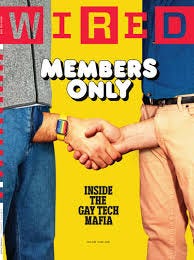
How, you might wonder, could that be only the second best gay cover of the week? Allow us to direct your attention to Wired, whose investigation into Silicon Valley’s supposed “gay tech mafia” did what we previously thought impossible: it out-New Yorked New York. The entire project is wild—and, we believe, could not have been executed at this level even a few years ago. In addition to the delightful and legitimately edgy cover, the story itself, by Zoe Bernard, slaps. So many of the quotes are so outrageous that we eventually stopped taking screenshots, but here’s a smattering: “Of course the gay tech mafia exists. This is not some Illuminati conspiracy theory. And you do not have to be gay to join. They like straight guys who sleep with them even more.” “Gays run this joint.” “If I were gay, I wouldn’t be having any trouble. That’s the whole thing with Silicon Valley these days. The only way to catch a break. Is if you’re gay.” “I mean, I wish Peter [Thiel] tried to groom me.” Bernard covers the hell out of the theory, interviewing dozens of gay movers and shakers and probing post-#MeToo ideas as well as the complex nature of gay culture. If this is what Katie Drummond’s Wired wants to be, well, that’s hot.
Is it perimenopause, or is it ADHD?
Two articles with exactly the same thesis and almost identical headlines—one in the Cut, one in the Atlantic—are here to frog-march us through the brain fog and force us to think, dammit, think! Between 2020 and 2022, the number of women ages 23 to 49 newly diagnosed with ADHD nearly doubled. This may have a hormonal culprit, but it could also be the result of historical under-diagnosis in girls… or it may be a case of current overdiagnosis across the board. Some broad takeaways: Not every midlife brain fog is created equal. If you’re blanking on words mid-sentence or don’t know how to spell something you’ve known for decades, that could be a sign of mild cognitive decline—a clinical stage that lies between healthy cognition and dementia. If you’re losing your keys or forgetting what you walked into a room for, that could be ADHD.
Read Yasmin Tayag’s brisk Atlantic explainer for just the facts, Jack.
Read Caitlin Moscatello’s more personal take in the Cut to hear from women whose brains felt like “a pinball machine” their whole lives, and who now wonder what could have been: If they’d been diagnosed with ADHD earlier, could they have gone to better schools, become doctors, dated differently?
George Santos was there. What could be sexier than that?
Lots of people wrote about the sex-positive fashion week partay thrown by the favorite magazine of the “womanosphere,” the dastardly misinformation-spewing Evie. (Founder Brittany Hugoboom—we’re still investigating whether that’s a real name—gets the Vanity Fair treatment by Marisa Meltzer here and pops up in WSJ mag here.) This party had a name, “Eros,” and at least one guest whose literal hair caught on fire? But don’t worry, conservatives. The issue, which will exist on zero newsstands, is supposed to bed-ucate married women only. Our favorite tidbit: Many of the influencers on site turned out to have no idea whose party they were at. They just got pinged by an app that senses influencers in the area—the force is strong, we guess—and invites them to parties.
Read “Pro-Trump journalists threw a sex-themed party. So did Pornhub. I went to both” in Slate here.
Read “Did Anyone at the Evie Magazine Fashion Week Party Read Evie Magazine?” in the Cut here.
Turns out “spread” is the most terrifying word in the English language.
As we witnessed our country’s potential (probable) next surgeon general stumble all over herself to avoid admitting that the flu vaccine keeps people from being hospitalized; watched measles cases tick up to 979 in South Carolina’s Spartanburg County; and read about this RFK Jr. ally / dangerous dipshit who wants his son to catch polio and measles—lines from Elizabeth Bruenig’s controversy-stirring Atlantic story kept floating before our eyes.
The controversy, for those who missed it: Bruenig employed an old-fashioned journalistic trick, constructing an imagined second-person scenario—not a real child, not her own family—to show how a measles death could happen circa 2026. Apparently the fictionalization factor was lost on readers including, embarrassingly, “a media ethicist and senior vice president at the Poynter Institute” and “a former World Health Organization communications director,” both of whom told the Washington Post they thought Bruenig was writing about her own family. (The story never said that nor, to our eyes, even implied it.) The Atlantic has since bumped up a warning label that probably should have been at the opening of the story all along—but can we get back to the point? This threat is R-E-A-L. Bruenig’s tale is dark enough for Grimm’s: it starts at a birthday party, where one infected, asymptomatic, unvaccinated child unwittingly showers guests with “microdroplets of mucus carrying the measles virus” like confetti from a popped balloon. We watch the droplets enter a little girl’s bloodstream, descending “upon her lungs, kidneys, tonsils, and spleen, down to the marrow of her bones.” We watch her mother take it in stride—colds are tough. From the pediatrician, to the hospital, to “becoming a data point in an outbreak”: this is a fast-slow horror-movie descent into an illness that shouldn’t even be happening. An illness we’re opting into.
Read “This is How a Child Dies of Measles” here.
Read “The Atlantic’s essay about measles was gut-wrenching. Some readers feel deceived” here.
U.S. Male, Not the Mall Chain
For those who identify as SMGs (Serious Magazine Geeks), Esquire legend Tom Junod has “finally” written a book: The Janes is an interlocking biography of Jane Goodall and Jane Fonda that explores themes of ambition among women born between the Great Depression and World War II. JUST KIDDING! Junod’s got a memoir about masculinity and fatherhood literally called In the Days of My Youth I Was Told What It Means To Be a Man. On its occasion, Esquire took the bait, producing a Junodian profile of Junod by John Hendrickson. Read “Tom Junod Finally Reckons With What It Means to Be a Man” here.
We’re Doing It All Wrong
We rarely quote at such length, but allow us to make an exception for the lead of Gillian Morris’s recent New York Times Opinion essay advocating for living with friends in adulthood:
When my friend and business partner, Phil Levin, and his wife, Kristen Berman, were planning for their first child, they didn’t go looking for a single-family home in the suburbs.
Instead, in 2019, the couple and five of their friends moved into two adjacent buildings in Oakland, Calif. Now there are 20 adults, eight kids and six buildings at the Radish, as the complex is known, where a communal meal is cooked almost every night, everyone helps with child care and the hot tub is always warm.
Once Phil and Kristen’s kids are asleep at 7 p.m., they can text one of their 18 friends next door, pass the baby monitor to whoever is home and head out. No babysitter, no preplanning — just an impromptu date night, like in the pre-baby days. Their friends have known their kids since birth and are comfortable intervening if needed.
“People talk about the first year of having a kid as extraordinarily challenging. I feel like a bit of a jerk for saying this,” Phil wrote in a newsletter, “but it’s been much easier than advertised for us. And we think our living situation plays a huge role in this.”
Have you ever read anything more convincing about…anything? Because we haven’t. Who’s ready to go in on a condo building?
Read “Why I Never Want to Have My Own Place” here.

Hash, Rehash
Is there a chicer way to say “chewing the cud”? Because that’s clearly one of our favorite activities around here. While we’ve already declared our undying love for Lynne Ramsey’s recent film Die My Love (and for The Testament of Ann Lee—twice), we’d like to do so again via a recent episode of the Blank Check podcast, on which hosts Griffin Newman and David Sims and their guest, Vulture critic Alison Wilmore, spend—we kid you not—three hours dissecting both DML and Jennifer Lawrence’s career. The insights are smart, funny, and got one Spreaditor through an entire week of carpool. Listen here, or wherever.
Talk about a cushy assignment!
In the new Vogue—Chloe Malle’s first at the helm—Alice Gregory goes on a personal quest for…new pillows. Because it was Alice Gregory—a writer so talented we’d read her riff on drying cement—we stayed the course, and you know, what? We learned a few things, including that the best pillows cost $700 and that we were, heretofore unbeknownst to us, yearning for a highbrow, literary Wirecutter/Strategist recommender that takes us all the way from the Upper East Side to Soho (whew!): Have Gregory and Malle created a new subgenre of service journalism? Here’s hoping! Also a promising sign: the story is illustrated by Spread-approved painter Noelia Towers.
Read “Pillow Talk” via AppleNews here.
Did someone forward you this email? To get the full Spread with all the fixins every week…
Huge congrats on this you both!!!
Congrats!!