
Welcome to Spreadlandia, where two veteran editors read it ALL to winnow out only the best: juicy yarns, big ideas, deeply personal essays, and hot goss—aka, the full Spread. Plus: original interviews, podcasts, and more. Come hungry!
Dear Spreadfiends,
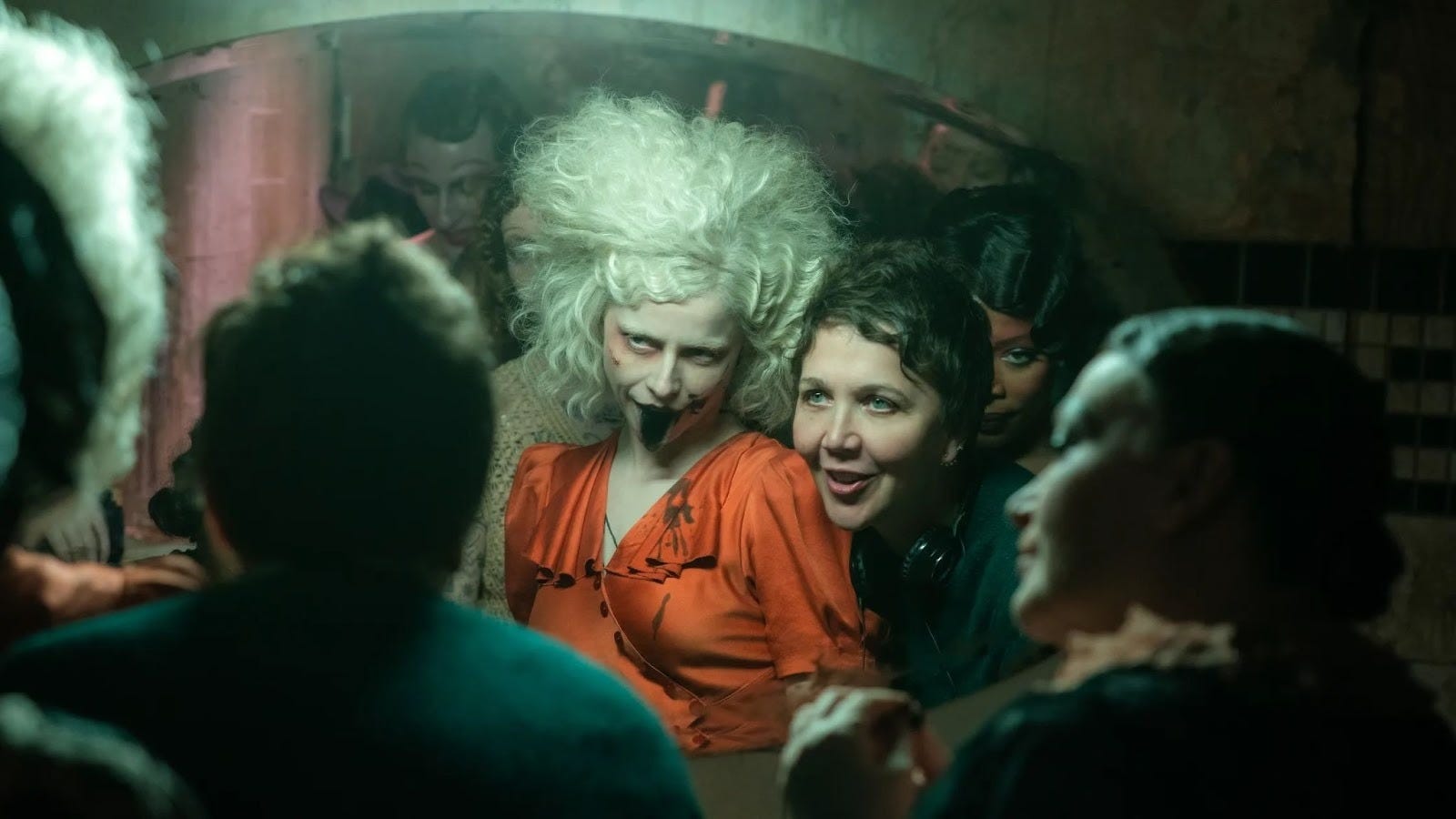
If you haven’t yet seen Maggie Gyllenhaal’s The Bride!, we can’t blame you. The reviews have been atrocious—if entertainingly so. Vulture’s Alison Willmore called it “more pussy hat than punk rock in nature, vague and mild-mannered underneath the occasional blood splatter and can-you-believe-we’re-getting-away-with-this posturing.” The Atlantic’s David Sims wrote that “any attempt by Gyllenhaal at conveying a message is drowned out by its overwhelming goofiness.” But we weren’t going to miss a Maggie G. picture, and surely not one for which she used her $100 million budget to cast her brother, her husband, her Batman, and her muse. If she was going there, so were we.
Once we settled in for a 6 p.m. showing, with a double pour of Sauv Blanc and a large popcorn “to share,” three thoughts struck like a triple-bolt of lightning. 1. We’d clearly be up all night peeing. 2. The salt bloat would be punishing. 3. Our favorite critics—who struggled to figure out what this movie is about—are apparently not in a certain phase of life, because The Bride! is clearly a meditation on perimenopause.
The gist of this wildly chaotic adaptation of the 1935 film The Bride of Frankenstein, itself a spin-off of Mary Shelley’s Frankenstein: The monster (Christian Bale, who we’d like to see work with more female directors—he looked to be having so much fun here!), who is now 117 years old and goes by Frank, is lonely, so he asks a mad scientist (Annette Bening!) to “reanimate” him a companion. They dig up the body of a young moll named Ida (Jessie Buckley), who was killed by mobsters after being possessed by the ghost of Mary Shelley (also Jessie Buckley—let’s not spend time on that here). Once reanimated, Ida, who is still possessed BTW, is told that she simply lost her memory after an accident. After Frank and Ida kill some people—self-defense, kinda!—they go on the run Queen & Slim-style Bonnie and Clyde-style, kill more people, fall in love. All with a detective (Sarsgaard) and his clever “assistant” (Penelope Cruz, slumming it) hot on their trail. Eventually Ida learns of her true backstory and decides her new name is “The Bride,” but before she can marry herself, more shooting occurs and both Ida and Frank are killed. But this is a Frankenstein movie! So of course they get reanimated and re-fall in love. It’s a lot.
OK, fine, you say—so why is this a perimenopause movie? Keep in mind that though the Ida/Bride character is given no age (Buckley herself is 36), Gyllenhaal, who wrote the film in addition to directing it, is a perfect 48 years young. Ahem:
The Bride seethes: Buckley’s character is pissed. Sometimes she flies off the handle for good reason; other times, her anger just festers. Familiar!
The Bride suffers “brain attacks”: These moments of split personality and/or mental blankness are parlayed into an entire plot point about women—not just the Bride herself, but also her followers—who use “brain attack!” as a rallying cry to confront men. “Brain freeze” is mentioned at least once, too. There’s even an original and extremely moody song called “Brain Attack” on the soundtrack. (No lyrics; apparently couldn’t recall them.)
The Bride’s got frizzy hair: Declining estrogen levels reduce the scalp’s natural oil production, leaving hair dry, brittle, and prone to breakage. Or so we’ve heard.
The Bride’s muscles are kind of stiff: One woman’s rigor mortis is another woman’s frozen shoulder.
The Bride’s skin pigmentation has gone haywire: Did someone say goth melasma?
The Bride has an identity crisis: And isn’t that just perimenopause in a nutshell?
The bottom line: Sure, this movie is messy as hell, but so are we, and we enjoyed a rip-roaring 126 minutes at the theater.
Turn on the fan on your way out, would ya?
Rachel & Maggie
We’re guessing In-N-Out wasn’t a hot afterparty stop this year…
By the time late March hits, we always feel a bit like football players in the days after the Super Bowl—it’s the end of our season, and we need some rehab, some anti-inflammatories, maybe a break from our teammates. We’re referring to the Oscars, of course. This year’s ceremony held few surprises, except for a feeling that built little by little, and that by the end of the show was fully aflame: outrage. If we had to look at one more skeletal clavicle, one more female bicep so scrawny it could barely hold up a statuette—we were gonna scream. In the days since, just like every year, many outlets (mostly tabloids) have noted the extreme thinness of Hollywood bodies—this time zeroing in on Emma Stone, Demi Moore, and Nicole Kidman. On Substack, Ruthie Friedlander, a fashion writer who has been outspoken about her own recovery from an eating disorder, summed it up with a great headline: “I Can’t See the Dresses Anymore, Can You?” But while Ruthie takes the gentler tack of hating the game, not the players—she’s right, of course: you can’t blame a person for their own illness—we are increasingly fed up with that approach, which has gotten us exactly nowhere. Where does the buck stop, if not with these rich, powerful, and established actors who run their own companies and call the shots on their projects, yet refuse to take an ounce of responsibility for what their own dwindling BMIs do to the minds of the women who keep them in business, buying tickets to their movies and slathering on the skin creams they shill? Do they feel no responsibility to us? And, fine, if we can’t put the blame on them, let’s put it somewhere. On the designers and stylists who dress them in clothes that emphasize their skinniness, celebrating it as a virtue. Or on the Louis Vuittons and Rolexes and Chanels of the world, which keep renewing their contracts, despite obvious shrinking that would give any “normal” person pause. Or on the doctors who may be renewing GLP-1 prescriptions well past the point of any logical weight loss. Or maybe just on the army of yes-men and yes-women who surround these people at all times, nodding like obedient little bobbleheads, taking their paychecks and their fringe benefits, and never stepping up to say: STOP THE INSANITY. At some point, somebody’s got to take the blame. Who’s it going to be?
A Talented Little Bitch Grows Up
Zac Posen, who has a reputation for being a technically talented designer and also a bit of a brat—both of your Spreaditors have experienced this first-hand so, yes, we’re starting shit but also, yes, we know whereof we speak—started his House of Z atelier at his parents’ place in Soho when he’d been on this planet for a mere 20 years. He quickly became fashion’s boy wonder, dressing hot young stars in his signature gowns and never missing a photo op for himself. Now, at 45, after his own company went bust, Posen is the creative director of Gap Inc., overseeing Gap, Athleta, Banana Republic, and Old Navy—a real man of the people! Some might call this a swerve. Some might call it a great reason to give him the New Yorker treatment! (We are both of those people.) Writer Rachel Syme pulls no punches (“Posen’s name-dropping has flowchart momentum, each acquaintance branching into subsequent friendships, projects, and parties.”) but her assessment is generous overall. Honestly, if you read one thing this week, this one’s a blast.
Read “How Zac Posen Went from Making Ball Gowns to Remaking the Gap” here.
Life on the Edge of Chaos
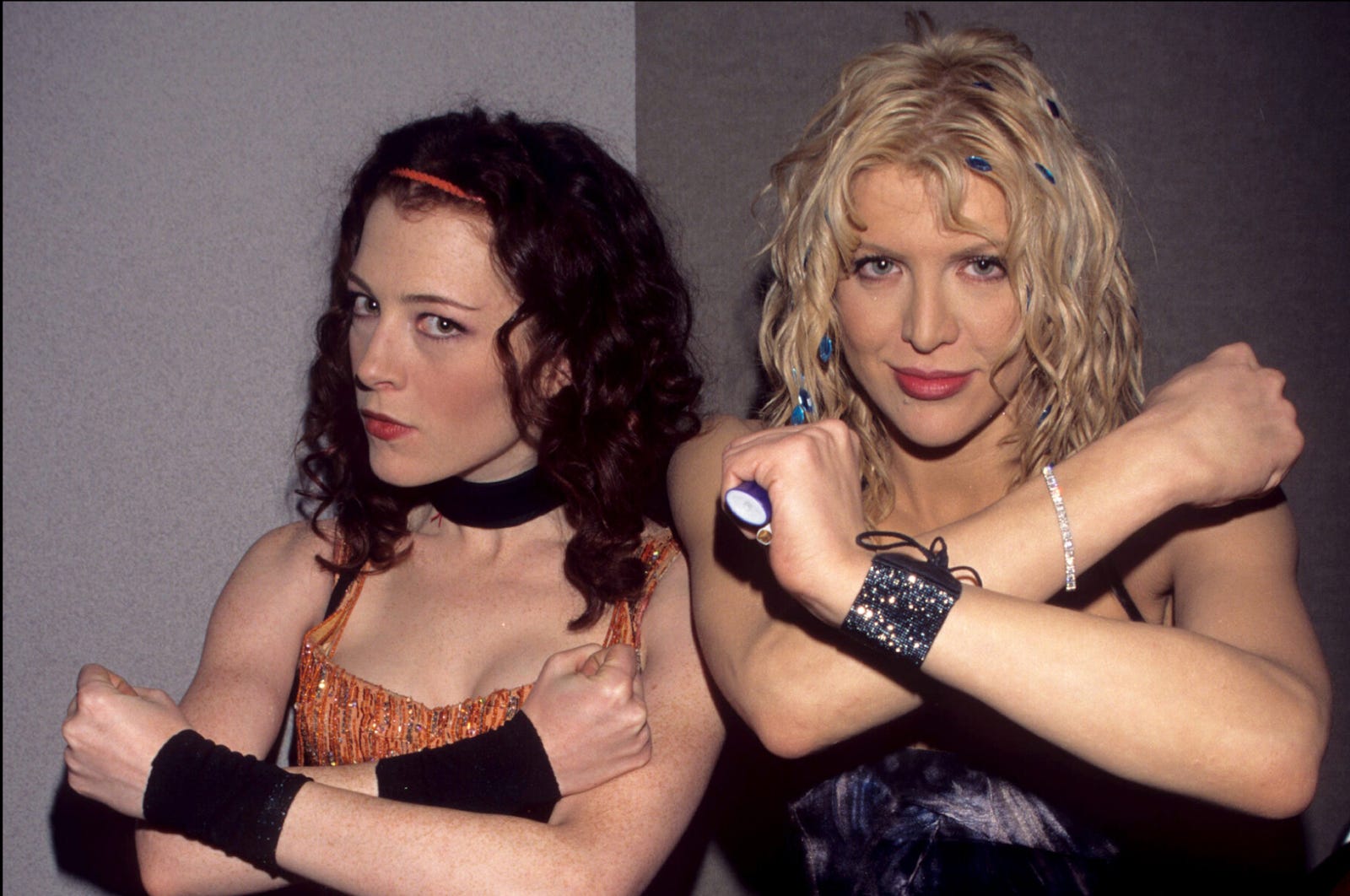
Anyone who wore drippy eyeliner and a dime store tiara to her mid-’90s senior prom in homage to Courtney Love (Maggie) will bow to the flame-haired rock goddess Melissa Auf der Maur, who joined Hole—the biggest-selling, most-Grammy-nominated female band of that tumultuous decade, but also one of its most dysfunctional—just four months after Kurt Cobain’s suicide, in the heat of both her bandmate’s heroine use and the country’s misogynistic anti-Love fever. In an excellent interview on NPR, the thoughtful and extremely well-spoken bassist reflects that writing Even the Good Girls Will Cry: A 90s Rock Memoir (out yesterday) was at least partially about processing (and exorcising) her past in order to be a more whole person and, ultimately, a better mother to her teenage daughter. There’s a Rolling Stone excerpt here, and we somehow missed this late-Feb New York Times profile (with great photos) by Melena Ryzik. Still, we’d love to see her get the New Yorker treatment by one of her peers, if anyone out there is listening. …Paging Ariel Levy and Emily Nussbaum?
Listen to the interview here.
Buy the book from our Bookshop here.
