
Welcome to Spreadlandia, where two veteran editors read it ALL to winnow out only the best: juicy yarns, big ideas, deeply personal essays, and hot goss—aka, the full Spread. Plus: original interviews, podcasts, and more. Come hungry!
Brilliant Spread-tectives,
The latest chapter in the Spread’s favorite literary whodunit landed Monday, throwing us into a tizzy from which we have yet to recover. It’s clear from the first graph of Jessica Bennett’s 8,500-word article in New York (nay, from the glowy, Elin Hilderbrand-coded cover shoot—love to be a fly on the wall for that editorial decision) that this is, to large degree, the story that Team Amy Griffin has been hoping for. By which we mean Amy Griffin, John Griffin, their crisis PR firm, their lawyers, and the countless famous people who went out on a limb to make her memoir, The Tell—about recovering horrific buried memories of sexual abuse that she allegedly suffered at the hands of a middle school teacher thirty years ago—a 2025 bestseller. Not so much in Amy’s boat anymore? Her ghostwriter, Sam Lansky, and her editor, Dial Press superstar Whitney “Whit” Frick—who, in this telling, have pretty much been tossed off the yacht in a burlap sack.
The big news here: For the first time, Bennett interviews all the major characters (though not the aforementioned Frick, and certainly not “Mr. Mason,” the man Amy accuses of rape, who has never come out of hiding). She got Amy herself, plus Joleene Altum, the woman who accuses Amy of stealing her own trauma story for The Tell, and—dun dun duuuun—the elusive “Claudia,” the pseudonymous middle school classmate who (stick with us here) is the person Amy says she spoke with before writing her book, while Altum alleges that the book’s “Claudia” is based on herself. The specifically poofy sleeves of the dress that one of these women borrowed from Amy for a middle school dance (the dress plays a big role in the book, in both Amy’s and Jolene’s lawsuits, and now in “Claudia’s” interview) are a character unto themselves in Bennett’s article1.
All of this is so confusing, it would take the rest of this issue to untangle it for you, and we’ve got other sh*t to do here today (if you don’t care a whit, so to speak, for the Amy Griffin story, keep scrolling: We’ve got fall’s best books! And this week’s other best reads!). And it is perhaps because this saga is such a beast to lay out that Bennett waits until the last third of her story to get into the remaining ambiguities in Amy’s account of things—where they may not attract the attention of anyone who hasn’t been watching this story like a pair of rabid chihuahuas (ahem).
We humbly submit:
Exhibit A: Amy has pulled off a sleight of hand that leaves us aghast and agog, and that even now nobody is really talking about: Over the course of her lawsuit filing and now this interview, she has artfully changed her entire story. Spreaders, the whole point of The Tell is that MDMA was the key that unlocked these awful memories. The book is very clear on this—these memories came to Amy for the first time after the drug kicked in. Now, she says these memories weren’t actually recovered, exactly: She sort of knew them before. The drug just helped bring them back more vividly. Wait, what?
Exhibit A.1: Even without the element of an illegal drug that is not proven to help “recover” memories—as Spreaditor Maggie reported here, some experts say it may do the opposite, distorting and exaggerating memories, potentially making them less reliable—such lost-and-found recollections, while devastating, have a way of not holding up in a court of law. With multiple lawsuits pending, that’s no coincidence.
Exhibit B: Amy finally addresses the tone-deaf editorial omissions that make The Tell feel less than genuine—and that were the first red flag to many lit-world insiders that this book might not totally check out. (One wonders whether, if not for these lost details, anyone would ever have bothered to dig deeper into Griffin’s story, opening up this whole slippery can of…caviar.) Now, Amy is ready to acknowledge that “questionable editorial choices,” as Bennett calls them, were made. But made by whom? That one is laid at the feet of Dial Press and, more subtly, Sam Lansky. They wanted to make the book more accessible to the non-billionaires of the world. They wanted to construct a compulsively readable, suspenseful narrative. Thus, The Tell skates past her vast wealth and prunes out a bunch of details that Amy now says would have brought her story to life and made it more believable.
Exhibit B.1: Amy can’t very well say that she made these choices, because the whole point is she’s defending her honesty and credibility, and, again—multiple lawsuits pending.
Exhibit C: Bennett takes perhaps the only route available to someone in her position—i.e., writing sympathetically about a story in which there are two purported victims—leaving room for the possibility (which seems very far-fetched to us, but then again who are we, Olivia Benson?) that both Griffin and Altum were attacked…on the same night… at the same school… by two different teachers.
Exhibit D: Keep reading for the story’s kicker, which is a total gut punch and, in our estimation, the single most compelling piece of evidence (even though it’s hearsay) from someone other than Amy Griffin to back up her version of events. Though as to why it’s just emerging now, your guess is as good as ours.
Exhibit E: WHAT ABOUT THE DANG POSTCARD?? Never mentioned in the cover story is The Tell’s dangling mystery of a postcard that Amy supposedly received in the mail, which she believed came from “Claudia.” The postcard is a flimsy detail that Griffin/Lansky weave the book’s whole ending around. Now, Bennett got “Claudia,” but no one’s clarifying whether that postcard actually exists or who sent it. 🕵️🕵️🕵️
So, is this the end of the Amy Griffin story? (And if so, what are we going to do with our free time? Mah-jongg? Ice climbing?) Or have we just cracked into a new chapter? In Monday night’s Dinner Party newsletter, Bennett suggested that the responsibility now lands with the publishing industry: “Like, ‘We don’t fact-check’ can’t just continue to be the answer from the publishers every time there’s a new scandal.” While we’d love to see that happen (don’t hold your breath), we’d also love to hear our gal Amy take some responsibility, at some point, for the flaws in The Tell (don’t hold your…).
Love,
Rachel & Maggie
P.S. What’s with all the umlauts in our title? Well if “JAŸ-Z” can get funky in the punctuation department, why can’t we?
The Spreadiest Books of Fall 2026!
Before we dive into the Spread’s fall booklist, could we all please pause and pre-order Julie Orringer’s new novel, Luna, Phoenix, Queen? First of all, you know it will be good—Orringer established herself as a bright light with her 2003 story collection, How to Breathe Underwater. Beyond that, buying the book feels like the right thing to do, now that we’re up at night worrying about Orringer’s writer-husband’s early-onset dementia (which informs a storyline in the new book), their two kids, and the not-cheapness of a Brooklyn existence. How is she going to make it work? Liz Egan—who, it must be said, is having A WEEK, what with this Amy Griffin story written by Bennett, a former Times colleague—captures their evolving love story beautifully in “What She Can’t Control in Life, She Could Control in Fiction,” here.
Now, onto the rest of the list!
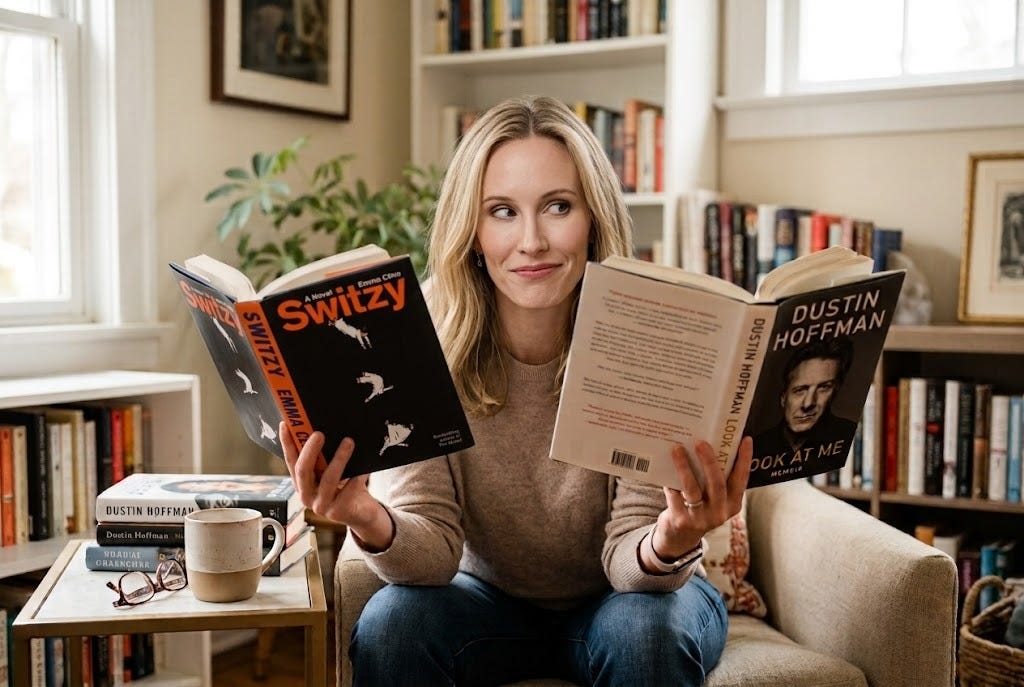
Switzy by Emma Cline, out now: In a major subject-matter swerve, The Girls and The Guest author’s latest follows a middle-aged man with dementia on his journey to an assisted-suicide clinic. Critics are raving. Buy it from our Bookshop here.
Exit Party by Emily St. John Mandel, out now: Set in 2031, the latest speculative novel from Station Eleven’s Mandel centers on a Los Angeles party where the host—poof—disappears. Buy it from our Bookshop here.
The Disappearers by Marlon James, out now: Dwight Garner isn’t the only critic to have a boner for this 640-page epic; it’s now the frontrunner for the National Book Award and the Booker Prize. Buy it from our Bookshop here.
End Times Fascism by Naomi Klein and Astra Taylor, out now: Klein and Taylor scare the bejesus out of us, then air a plan for how to get out of the Christian-nationalist-and-tech-bro-fueled garbage fire that is our burning planet. They talk to David Marchese about it here. Buy it from our Bookshop here.
The Vanishing Family by Robert Kolker, September 29: Based on a 2023 New York Times Magazine story, the book goes deep on a Pennsylvania family reckoning with an ultrarare, inherited form of frontotemporal dementia: Each child carries a 50-50 chance of having the gene mutation. (Anybody who loved his Hidden Valley Road—about a family of 12 children, six of whom had schizophrenia—will be hooked.) Pre-order it from our Bookshop here.
American Hagwon by Min Jin Lee, September 29: The title sounds like how your Spreaditors wake up looking, but the book (by the author of Pachinko) actually takes on the pressure cooker that is private tutoring when an achievement-focused Korean family settles in Southern California. Paging Apple TV? Pre-order it from our Bookshop here.
Partita by Barbara Kingsolver, October 6: We haven’t been this excited about a Kingsolver novel in a minute. A married piano teacher’s phone rings, and guess who? An old lover from her conservatory days. And then…! For a warm-up, read Casey Cep’s New Yorker profile from this week here. Pre-order it from our Bookshop here.
Fair Ones by Lydia Millet, October 6: From the wild mind behind the Spreaditor-beloved A Children’s Bible, this “double novel” follows two women as they grapple with the violent death of a mutual friend. We’re waiting for a Spready profile on Millet to drop in 3…2…1… Pre-order it from our Bookshop here.
Every Story Is a Love Story by Imbolo Mbue, October 6: The How Beautiful We Were author’s new novel has a gut punch of a concept: A man’s pregnant wife gets hit by a car in New York City and dies. Months later, he receives a letter from the driver, inciting questions about grief and forgiveness. Whew. Pre-order it from our Bookshop here.
Peck & Peck by Bonnie Garmus, October 13: The follow-up to surprise superseller Lessons in Chemistry is about an entry-level mailroom worker at a prestigious poetry magazine! Will Garmus be able to keep up her winning streak? Pre-order it from our Bookshop here.
The Brightness by Chad Harbach, October 27: Sixteen years since The Art of Fielding hit hard, Harbach’s second doorstopper is also a coming-of-age tale, this time about two women named Irma and Pella whose lives spin out into unexpected directions starting at a Block Island wedding. Maggie, who has often daydreamed about writing a novel set in Block Island, is so, so happy for him. Pre-order it from our Bookshop here.
Look at Me by Dustin Hoffman and Ariel Levy, November 10: We’re going forgo Sylvester Stallone’s and Michael Douglas’s new memoirs, sorry, but we will certainly brake for Hoffman’s, which was cowritten by forever Spreadfave (and now 60 Minutes correspondent) Ariel Levy, and says so right out front. Kinda makes you like him, doesn’t it? Pre-order it from our Bookshop here.
Annie Proulx Stories: New & Selected, November 10: A nothing-but-net gift for the hard-to-buy-for Proulx girlie or a lil treat for your own bedside. Pre-order it from our Bookshop here.
Rabbit Rabbit by Jennifer E. Smith, December 15: 39-year-old Billie decides it’s now or never: She’s going to have a baby on her own. Infertility treatments meet “global romantic getaways.” Send this one to AOC! Pre-order it from our Bookshop here.
The Spreadiest Reads of the Week!
Talking Out of School
Over the weekend, Nikole Hannah-Jones—Pulitzer Prize-winning architect of the 1619 Project and foremost justice-focused education reporter—rocked the parental world with the publication of an article second-guessing her own parenting choices and in turn her life’s work: In line with her values and informed by her reporting, she’d sent her daughter to a predominantly Black and under-resourced neighborhood school. But when her daughter got to middle school, she felt betrayed that her parents would choose an education for her with less opportunity than they could have conceivably afforded. It’s an astounding work of contrition and humility that raises as many questions as it answers and as of this writing has inspired more than 1,600 comments. Among the most poignant parts of the article comes when Hannah-Jones interviews the now 71-year-old Leona Tate, who at age six was one of the first Black children to desegregate a southern elementary school: “It wasn’t easy for us, but we had to.” Tate tells her. “I think it was a hard decision, a courageous decision, to put your children on the front line like that. And I probably would do the same thing. I’m glad I did what I did when I did it. Somebody had to do it.”
Read “In Fighting for Every Black Child, Did I Betray My Own?” here.
