
Welcome to Spreadlandia, where two veteran editors read it ALL to winnow out only the best: juicy yarns, big ideas, deeply personal essays, and hot goss—aka, the full Spread. Plus: original interviews, podcasts, and more. Come hungry!

From the Department of Expectation Management: Contrary to this issue’s subject line and the above photograph, this newsletter has nothing to do with basketball. We’re just feeling the vibe!
Speaditarians,
“Misophonia got ya down?” asked one Spreadspouse recently, as he flagrantly crunch-slurped a bowl of peanut butter Puffins in the glare of her white-hot and perfectly justified rage. Was she imagining things or was he really leaning into it, just to send her over the edge?
Misophonia is a condition that has a lot in common with the human condition, writes Sloane Crosley in the New Yorker, and—just throwing a little gasoline on the fire here—we believe, even more to do with the female condition. “Who among us has not experienced an inability to ignore repetitive tapping, clicking, chewing, smacking, and sniffling?” she writes. Well, sure, if the “us” here is female. Most men we know are not bothered.
The affliction is very on trend. It has its celebrity complainants (January Jones is still a celebrity, right?) and even got its own day: World Misophonia Awareness Day will be here before you know it, on July 9! It has become acceptable to deliver noise complaints via violently worded novelty mugs (“If I can hear you chewing, I have fantasized about your death”) and T-shirts (“Chew louder—I dare you”). Yet, while we estimate that 50 percent of our friends think they suffer from it—all women: hmm!—misophonia still isn’t an official diagnosis, partly because it defies categorization. Is it an audiological condition, or a psychiatric one? Or are you just being pissy?
Turns out not being able to sit in the same room with your fellow Spreaditor as she slurps her tea, or feeling enraged by upstairs neighbors who stomp around in five-inch heels (remember Carrie Bradshaw’s miswritten-as-male buildingmate Duncan Reeves?) is mere “amateur suffering.” For those with the real-deal neurological condition, repetitive tapping, clicking, chewing, smacking, sniffling, gulping, slurping, sighing, crunching, phlegm-clearing, and coughing—oh god, just writing this list!—doesn’t just make you mad. It provokes a full-blown chest-tightening, heart-racing, sweaty fight-or-flight response. Real misophonia can end marriages, upend childhoods, and leave people tortured, often in secret, because they fear judgment or ostracism. It’s “an actual, severe, life-altering condition, 24/7,” argues one sufferer. And the rest of us regular old irritable folk who just can’t possibly peaceably coexist with other people who chew? We trivialize it by claiming it for ourselves.
To be honest, Crosley’s story left us wondering if we might be big old babies or, worse, intolerant dicks. People with actual misophonia are often consumed by shame. They’re telling themselves, “I’m bad, I’m broken, I’m terrible.” They’re not going around mad at everybody else for… human-ing.
Popping our chill pills,
Rachel & Maggie
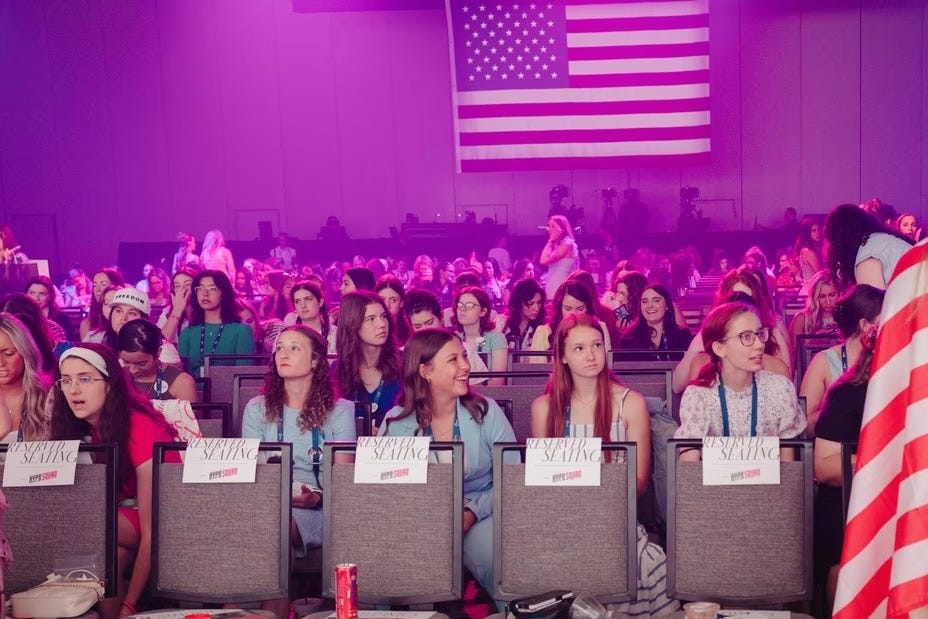
Erika Kirk’s Bigger-Tent Party
If you’ve finished Yesteryear and find yourself missing your time wading in an ocean—Shannon, what’s an ocean?—of contradictions around ideas about femininity, Christianity, and the American project mixed with a heaping fish soup of self-righteousness, look no further than Atlantic staff writer Elaine Godfrey’s second pilgrimage to San Antonio for Turning Point USA’s annual Women’s Leadership Conference. (If you haven’t finished Yesteryear, you too should read this dispatch; it’s a model of the reporter-in-a-foreign-land genre, packed with laugh-out-loud observations from our woman on the ground.) A lot has changed since last year’s convening, which occurred a week before founder Charlie Kirk was assassinated. For starters, Erika Kirk is now CEO, bringing to the project a shot of girlboss ambition. And whereas previous conferences were explicitly political, all out pro-Trump machines (two years ago, the speaker lineup included Lara Trump, Candace Owens, Megyn Kelly, and Alina Habba, Esq.!1 and you know how that movie ended), Godfrey hears not one single mention of the midterms or even, uh, voting, from the dais. Instead, she writes, the vibe was more you-go-girl Christian empowerment, reaching out to housewives and single, working women alike. One woman she interviewed captured the (previously radical for these parts) sentiment thusly: Womanhood “can be a little bit nuanced.”
Read “A Disorienting Weekend With the Women of Turning Point” here.
“Totally Normal Person”
Teny Geragos is the common thread between the defense teams of P. Diddy, the Alexander brothers, and Harvey Weinstein. At 35, this very reasonable-seeming, measured woman has the seriousness and credibility that Trump attack dogs like Alina Habba, Esq.!—DRINK!—lack, which has quietly made her the face of a post-#MeToo legal era: the woman who famous men call when they’ve been accused of sexual misconduct. Geragos is the kind of gal who can sound somewhat empathetic to the violence suffered by Cassie Ventura—which, after all, was never up for debate—and in the next breath describe Combs beating Ventura in a hotel hallway as him “not being his best self.” She argues that the work she does emphasizes the power of women—who, after all, are the ones whose stories everybody believes (!!). She doesn’t want to be the one to call the men she defends victims but if the Italian loafer fits… “Nobody is more powerful in a courtroom or in the government than a woman.” Says the woman who helped get Diddy off on the worst of his charges, and won Weinstein a recent victory.
Read it here.
GLP-1s are coming for us—whether we want them or not.
What do you do when you’ve publicly declared yourself proudly fat, and your doctor tells you the only way to cure your health problem is to go on a GLP-1 and lose 50 pounds? One of our favorite Vogue voices of recent years, Emma Specter—she of the “68 Thoughts I Had While Watching Office Romance”2 listicle, a format that we cannot resist and sometimes boldly rip off—has made her bigger body part of her journalistic project. In 2024 she published a memoir about accepting her shape and overcoming what she calls her former “soft anorexic” disordered eating. Then along came a “forever period” that lasted two years. It was endometriosis (which btw affects one in ten women, and one in two Spreaditors); the fix, her doctor told her rather flippantly, was to go on Zepbound. Specter is conflicted on multiple levels: worried about being a shill for Big Pharma, worried about letting down the fat liberation movement, worried about being a 32-year-old who relies on her mother to pay her bills because the meds cost $400 a month, out of pocket. Worried about unconsciously trying to present herself as a “good GLP-1 user”—unlike the thin people who use them to get even thinner. Worried about reabsorbing “the messages I’ve worked so hard to shed about body size being inherently tied to worth—which I fear I might if I keep losing weight.” On the other hand, this shit works. That perpetual period? Synced right up.
Read, “I Didn’t Want Weight Loss to Be the Thing That Cured Me. It Did Anyway” here.
Still spitballing here: Maybe “Fathtrescnence”?
We have been on the New Dads Are Depressed (NDAD) beat for a while now, so when we saw the Cut headline “Postpartum Depression is Coming For Fathers,” we said what we always say in response to the topic : Sure, but do they have to call it “postpartum depression”? Can’t we reserve some distinction for the birthing parent? And then we read the piece, by Emi Nietfeld, which is so excellent we forgot about our nomenclature beef. So excellent even that it should be passed out to “secondary” parents as enthusiastically as mesh undies and squirt bottles are handed to their partners. When Nietfeld gave birth to her child, she happened to have an absolutely blissful postpartum period; her husband, on the other hand, spiraled. Inside her tender, first-person framing, Nietfeld interviews a handful of depressed and anxious new dads (one had the kind of intrusive thoughts we’d previously only heard new mothers cop) and gets into the wild and persuasive brain science that can accompany new fatherhood. According to USC psychology professor Darby Saxbe’s research, “New fathers’ brains experience similar shifts to moms’ brains, including losing gray-matter volume in areas associated with executive functioning, visual processing, attention, and empathy — even though they’d never been pregnant, never given birth, and never breastfed. The men who spent more time with their infant and more time as primary caretaker experienced more changes.” Sounds like filling out the mood survey at the ped appointment should be a family affair.
Read it here.
