
Welcome to Spreadlandia, where two veteran editors read it ALL to winnow out only the best: juicy yarns, big ideas, deeply personal essays, and hot goss—aka, the full Spread. Plus: original interviews, podcasts, and more. Come hungry!
Welcome, welcome, new (and faithful) readers!
A fresh crop of you arrived in Spreadlandia following last week’s news of our ASME nomination—a nomination that we reserve the right to mention early and often—and we are overjoyed to have you here. Hope you’re hungry!
If you are indeed new here, you might not know that we are an unofficial Amy Griffin ’zine. We’ve had our noses to the ground on the case of the billionaire memoirist and friend-of-Reese since a year ago, when Vogue published a strangely oblique excerpt of what would become Griffin’s bestselling 2025 memoir, The Tell—in which Griffin recounts horrific memories of rape by a middle school teacher, which she says she unearthed while on MDMA. In September, Elisabeth Egan and Katie Rosman of the New York Times poked significant holes in Griffin’s claims in this investigative feature. And soon thereafter, our own Maggie probed a specific piece of Griffin’s puzzle—whether MDMA can really help us uncover buried memories. (CliffsNotes: Probably not.)
After the Times exposé, we expected Griffin to abscond to one of her private islands. Instead, she stuck to a strict “keep on keepin’ on” strategy, adding the actual New York Liberty to her portfolio; hanging with our spiritual auntie Leanne Morgan; snuggling Gloria Steinem. (See this week’s Fortune story about Dr. Becky’s $34 million parent advice empire, backed by one Amy Griffin.) Right this minute, Amy is probably in some private Italian hospital suite, massaging her buddy Lindsey Vonn’s left foot.
Well, no. Right now she’s definitely in the boardroom of a crisis PR firm. (Right?)
Today, Rosman and Egan are back with the news that in California, a former middle school classmate has filed a lawsuit against Griffin alleging that The Tell’s stories of sexual assault aren’t Amy’s stories at all—but rather, her own. Our collective Spread mind exploded. Then we swept the bits into these seven talking points.
1. The Tell’s central thesis is that Amy’s identity as a “good girl” defined her whole existence. Evidence of this goodness begins and ends with that time she loaned a dress to another girl in middle school. Reading the book, we thought, again and again: Really—we’re still talking about one dress, one time? This lawsuit is filed by the girl who borrowed that dress. She is known in court papers as Jane Doe.
3. Besides Griffin, Jane Doe’s suit also names publisher Random House and The Dial Press—no great surprise—but also ghostwriter Sam Lansky, which we’re told is not unheard of in cases like this.
4. We continue to be amazed, astounded, just completely knocked out by the fact that this book was published without adhering to basic legal and ethical standards, like, um, giving the people you’re writing about a heads up—and that this is not regarded as some kind of historic publishing world malpractice. Folks, this thing went all the way to print, to Oprah, to Goop, to every “platform” you can think of without anyone ever reaching out to the former teacher Amy remembers raping her. He is known in the book (and now, on Reddit, Instagram, you name it) by a pseudonym, Mr. Mason, but is apparently easily identifiable in the smallish town of Amarillo, Texas, based on the book’s description.
5. The Tell is full of Amy’s highly specific, graphic mental images from her alleged attacks. Jane Doe has horrifying details of her own. When a teacher raped her, she says, the bandana he stuffed in her mouth “caught on her braces.”
6. Just, woah. Jane Doe says that though she was raped by a teacher, it is not the teacher described in The Tell. If this is true—and we have no evidence so far that says it is—the man Griffin calls “Mr. Mason” has been wrongly accused and likely exposed in his community in a way that can never be repaired.
7. And here’s the one that stopped us in our tracks. The suit alleges that in 2022, Jane Doe was contacted by someone claiming to be a talent agent and producer who “expressed an interest in using her life story” for film or television. She says she met with this person and in their conversations revealed her story of middle school sexual abuse, and that the person then ghosted her. (Weird on many levels: Why would she believe that someone wanted her story, out of the blue? Who is this person? Assuming they exist, were they hired by Griffin?) Three years later, The Tell comes out. According to Jane Doe, it features her own horrors—in someone else’s life story.
So where does this leave us? Despite the New York Times investigation, and what we also know about how MDMA works (and doesn’t), it was possible to doubt parts of The Tell, while still giving Griffin herself the benefit of the doubt. Maybe Amy had not intentionally misled anyone, but really believed her MDMA-induced visions, even without evidence to support them. Or maybe, despite the lack of any shred of proof—which we know can happen in rape cases, especially those that happened 30 years ago—it was true.
No one wants to doubt a victim, after all—least of all the kind of women who have publicly backed (and, um, been financially backed by) Amy Griffin.
But now? It’s time for receipts. Phone records. Questions must be answered. It’s hard to imagine this thing ever making it to trial—don’t deep-pocketed people usually settle before a case like this even makes it to court, to avoid the scandal and legal hassle? But if this one does, we’ll see if a jury will give Griffin the same benefit of the doubt that her powerful peers have been willing to.
Just the facts ma’am,
Rachel & Maggie
P.S. In much happier news, shout out to our Substack sister and phenom, Sari Botton, whose very deserving Oldster Magazine mag got the New York Times Styles treatment this weekend. “Everyone who’s alive and aging is an oldster,” she says. Count us in.
We want to grab a smoke with Charge Nurse Dana.
She was already our favorite American; one Spreaditor and her Spread-husband have been barking the words “Baby Jane Doe” at each other for weeks now. But in season two, episodes 7 and 8, of The Pitt, Charge Nurse Dana (aka Katherine LaNasa) taught us more about rape kits—the specific evidence gathered, how it works—than all the articles we’ve read on the subject put together. The story arc was written with input from the UCLA Health Rape Treatment Center and Pittsburgh Action Against Rape. “But what makes this storyline so notable is the way the writers foreground trauma without sensationalizing it,” writes the nonprofit Feminist on Instagram—indeed, you never hear the story of what happened, how, or by whom: “By withholding the details of the assault, the writers deny viewers the narrative cues we might normally rely on to validate trauma. Instead, the story remains anchored in the survivor’s agency, Nurse Dana’s compassion, and the exhaustion threaded through each step of evidence collection.” Anyone who has been violated deserves this kind of careful, methodical, loving care. And anyone who can handle watching these episodes should—no matter their gender.
Putting the I in Power
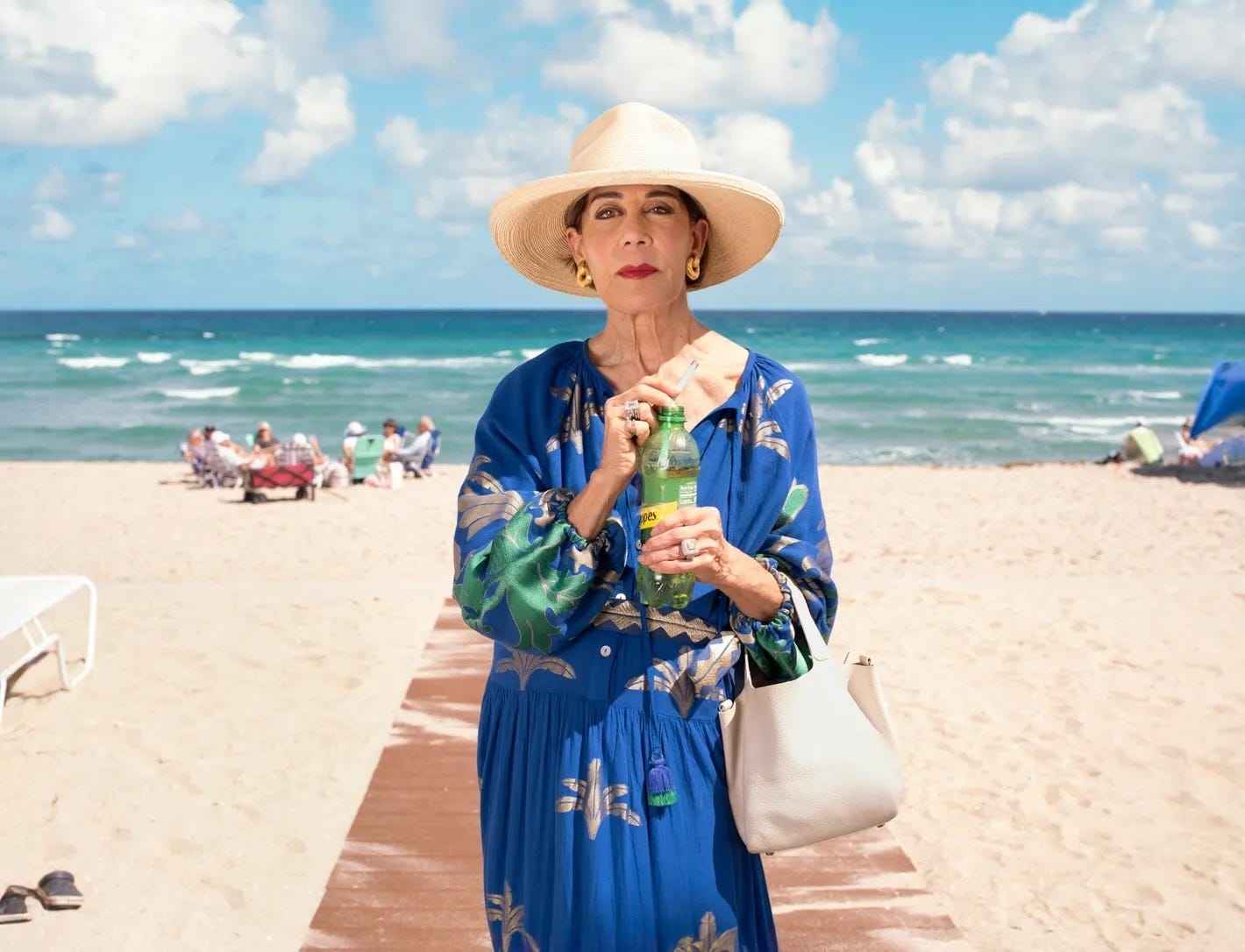
In their new post-Epstein profile of exiled power broker Peggy Siegal, New York’s Jessica Bennett and Katie Ryder didn’t need literary fireworks. Instead—with visual assists from portrait photographer Gilliam Laub and an obviously crackerjack photo researcher because dang the archival shots hit—they handed her a rope and a stool and left her to her own devices. Siegal, who for decades was considered the queen of connection among Hollywood and New York City’s entertainment industry elite, lost her standing in an instant in 2019 when she was revealed to be a social enabler of Jeffrey Epstein. But she remained cagey about the extent of their relationship, claiming she had attended a dinner or two and that, of course, there were film screenings. With the recent avalanche of released files, however, she’s got nowhere to hide, and evidenced by her participation in this story, nothing to lose: More than 5,000 emails between Siegal and Epstein have been made public, and Bennett and Ryder got the story from the pasture pet’s mouth. Though Siegal maintains that she was not privy to Epstein’s crimes involving underage girls, the story reveals an almost codependent friendship that ran on compliments, access, and connections. Also: lots of money. Epstein would open his wallet to support Siegal’s lifestyle, especially travel to power-studded locales, and Siegal would open her Rolodex to support his. It all adds up to a close-up of how these kinds of mutual, uh, backscratch relationships actually work at the highest levels of power. And a reminder of how satisfied we are with our own $39.99 ErgonomicLux.
Read “The Grande Dame of the Epstein Files” here.
